
Government to Recruit Teachers in Phases as Ghana Faces Shortage of 98,000 Teachers

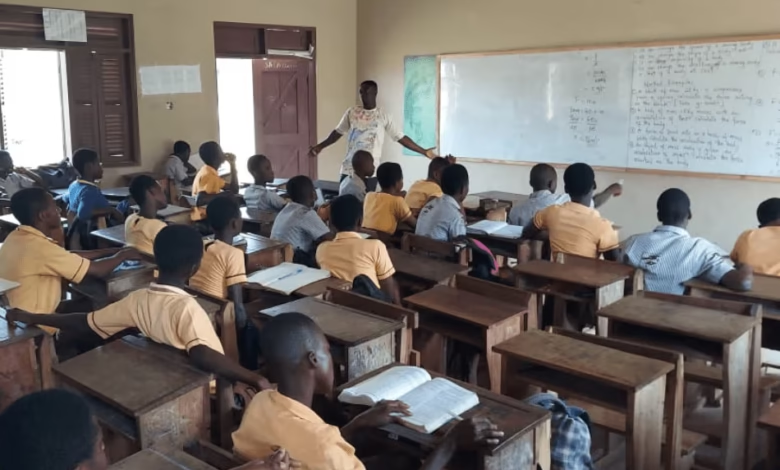
The Minister for Education, Haruna Iddrisu, has disclosed that Ghana requires about 98,000 teachers to adequately staff schools across the country, but the government’s current compensation budget cannot accommodate the recruitment of all trained graduates at the same time.
Speaking on TV3’s New Day on March 5, the minister explained that the government is preparing a joint memorandum between the Ministry of Education (Ghana) and the Ministry of Finance (Ghana) to seek Cabinet approval for the phased recruitment of trained teachers from recent graduating cohorts.
“Ghana will need about 98,000 teachers to be recruited, but the compensation budget of government cannot accommodate that,” Mr. Iddrisu stated.
According to him, the planned memo being developed together with the Finance Minister will request approval to begin recruiting teachers who completed their training between 2023 and 2024, while graduates from the 2025 cohort are expected to be considered later.
“The Minister of Finance is doing a joint memo with the Minister of Education for Cabinet to give approval for the recruitment of a cohort of teachers from 2023 to 2024, and very soon we will have 2025 added,” he explained.
However, the minister emphasized that the recruitment process will be done gradually due to budget limitations.
“We cannot take all of them at the same time, but we will certainly absorb some numbers. At a minimum we should be doing about 6,000 to 10,000 to start with in order to respond to the needs across the country,” he noted.
Beyond the issue of teacher recruitment, Mr. Iddrisu expressed concern about what he described as a decline in the quality of basic education in Ghana, stressing the need to strengthen foundational learning among pupils.
ALSO READ: No More Teacher Licensure Exams in Ghana as Education Minister Announces New Certification System
He revealed that Ghana has secured about $118 million in support from development partners to help improve foundational literacy and learning outcomes.
“The quality of basic education is declining and we need to strengthen foundational learning,” he said.
As part of ongoing reforms, the Education Ministry is also encouraging the use of local languages in early childhood education, arguing that children learn more effectively when taught in their mother tongue during their formative years.
“English remains Ghana’s official language, but we are encouraging as much as possible the use of local languages in the formative years because children learn better when they are taught in their own language,” the minister noted.
He cited examples of how local languages are being promoted in schools across various regions. In the Greater Accra Region, for instance, schools are being encouraged to teach Ga, while Twi is promoted in Akan-speaking areas and various Mole-Dagbani languages are used in northern communities.
Mr. Iddrisu further revealed that there are proposals to expand the list of officially recognized languages used in schools.
“Currently we have a request to include Builsa, and Ghana presently has 12 officially recognized languages,” he added.
The government believes that the combined strategy of phased teacher recruitment, increased funding for foundational learning, and expanded local language instruction will help improve learning outcomes at the basic education level across the country.
Join our WHATSAPP CHANNEL, WHATSAPP GROUP 1, WHATSAPP GROUP 2 and TELEGRAM CHANNEL to get all relevant teaching resources to make your lessons effective.
Subscribe to this blog and follow us on facebook


